
The Kansas CDL Manual is a vital resource for aspiring commercial drivers, detailing requirements for operating vehicles exceeding 26,001 pounds GVW/GCWR.
Understanding the Kansas Department of Revenue guidelines, including CFR 383.25(a)(1), is crucial for safe and compliant commercial driving operations.
What is a Commercial Driver’s License (CDL)?
A Commercial Driver’s License (CDL) is a specialized driver’s license required for operating commercial motor vehicles (CMVs) in Kansas. These vehicles are defined by their weight or the type of cargo they transport, necessitating a higher standard of driver qualification.
Specifically, a CDL is mandatory for anyone operating a single vehicle with a Gross Vehicle Weight (GVW) of 26,001 pounds or more, or any combination vehicle boasting a Gross Combination Weight Rating (GCWR) exceeding the same threshold.
Obtaining a CDL demonstrates a driver’s knowledge and skills to safely operate these larger, more complex vehicles, adhering to both federal regulations (like CFR 383.25(a)(1)) and specific Kansas state laws. It’s more than just a license; it’s a certification of competency.
Who Needs a Kansas CDL?
A Kansas CDL is required for individuals operating vehicles designed to transport passengers or hazardous materials, or those exceeding specific weight limits. This includes drivers of large trucks, buses, and vehicles carrying dangerous goods.
If you operate any single vehicle with a Gross Vehicle Weight (GVW) of 26,001 pounds or more, a CDL is legally required. Similarly, operating a combination vehicle with a Gross Combination Weight Rating (GCWR) of 26,001 pounds or more also necessitates a Kansas CDL.
Even if your vehicle can operate legally without a CDL, transporting certain hazardous materials automatically triggers the CDL requirement, ensuring driver competency and public safety.
Gross Vehicle Weight (GVW) and Gross Combination Weight Rating (GCWR)
Gross Vehicle Weight (GVW) represents the total weight of a single vehicle, including its chassis, body, engine, passengers, and cargo. Understanding GVW is crucial for determining if a Commercial Driver’s License (CDL) is required in Kansas.
Gross Combination Weight Rating (GCWR), conversely, applies to vehicles towing trailers or operating as tractor-trailer combinations. It’s the maximum permissible weight of the combined vehicle and trailer.
In Kansas, a CDL is mandatory for any single vehicle exceeding 26,001 pounds GVW or any combination vehicle surpassing 26,001 pounds GCWR, as outlined in the official Kansas CDL Manual.
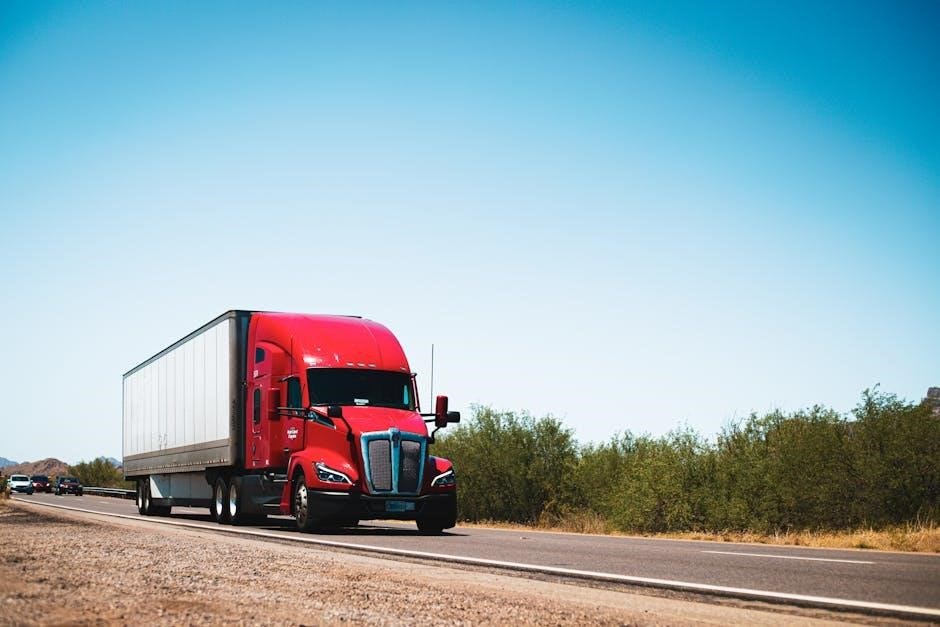
Obtaining the Kansas CDL Manual
The Kansas CDL Manual is accessible through the Kansas Department of Revenue, with versions dated March 2025 and June 2022 available.
Find it online or potentially via Amazon (9798307207154), ensuring you have the latest state-specific regulations and requirements.
Where to Find the Official Manual
The official Kansas Commercial Driver’s License (CDL) Manual is primarily available through the Kansas Department of Revenue ー Division of Vehicles. Prospective drivers can directly access and download the manual from their official website, ensuring they have the most current and accurate information regarding state-specific regulations and federal guidelines.
Alternatively, a physical copy may be obtainable through certain Kansas Department of Revenue offices. Furthermore, the manual is also listed for purchase on Amazon.com, identified by its ISBN 9798307207154, offering a convenient option for those preferring a hard copy. It’s crucial to verify the publication date to ensure alignment with the latest updates and amendments to Kansas CDL laws.
Always prioritize obtaining the manual from official sources to avoid outdated or inaccurate details.
Manual Version Dates & Updates (March 2025, June 2022)
Staying current with the Kansas CDL Manual is paramount, as regulations are subject to change. The most recent version, dated March 2025, incorporates the latest amendments to state and federal commercial driving laws. Prior to this, the June 2022 version was the prevailing standard, reflecting updates implemented at that time.
Drivers should always confirm they possess the newest edition before preparing for knowledge or skills tests. The Kansas Department of Revenue regularly updates the manual to align with evolving safety standards and legal requirements. Checking the publication date – CDL 10 (rev. 08/01) – ensures compliance.
Using an outdated manual could result in incorrect information and potential test failures.
Copyright Information (AAMVA)
The Kansas Commercial Drivers License Manual is protected by copyright held by the American Association of Motor Vehicle Administrators (AAMVA). This copyright safeguards the intellectual property contained within the manual, including all text, images, and organizational structure.
AAMVA establishes national standards for driver licensing and record-keeping, ensuring consistency across states. Unauthorized reproduction, distribution, or modification of the manual is strictly prohibited.
The designation COPYRIGHT AAMVA clearly indicates these protections. Drivers are permitted to use the manual for personal study and preparation for the CDL exam, but commercial use requires explicit permission from AAMVA. The manual version is CDL 10 (rev. 08/01).
CDL Classifications in Kansas
Kansas CDL classifications – A, B, and C – determine operational privileges based on vehicle weight and configuration, including buses and combinations.
Class A handles over 26,001 lbs GVWR, while Class B is under that limit, and Class C varies.
Class A CDL
A Class A CDL in Kansas permits operation of any combination vehicle with a Gross Combination Weight Rating (GCWR) of 26,001 pounds or more. This includes tractor-trailer combinations, and any large combination of vehicles exceeding the weight threshold.
Drivers holding this classification demonstrate proficiency in handling complex vehicle dynamics, requiring extensive skills testing. The Kansas CDL Manual details specific requirements for obtaining this license, referencing CFR 383.25(a)(1) for federal regulations.
Successful applicants must pass both written knowledge and skills (driving) tests, navigating the modernized testing system implemented by the Kansas Department of Revenue. Understanding weight restrictions and proper vehicle control is paramount for safe operation.
Class B CDL
A Class B CDL in Kansas authorizes the operation of single vehicles with a Gross Vehicle Weight Rating (GVWR) of 26,001 pounds or more. This commonly includes large buses, and straight trucks, but not tractor-trailer combinations.
The Kansas CDL Manual outlines the specific knowledge and skills required for this classification, referencing federal guidelines like CFR 383.25(a)(1). Drivers must demonstrate competence in handling heavier vehicles and adhering to safety regulations.
Testing involves both written examinations and practical driving assessments within the state’s modernized testing system. A bus can fall under Class B if its GVWR doesn’t exceed 26,001 pounds.
Class C CDL
A Class C CDL in Kansas is required for operating vehicles not meeting the criteria for Class A or B, but still designed to transport 16 or more passengers (including the driver), or transporting hazardous materials requiring placarding.
The Kansas Commercial Drivers License Manual details the specific requirements for this license, encompassing knowledge of safety procedures and vehicle operation. It’s crucial to understand the regulations outlined in CFR 383.25(a)(1).
Testing includes written knowledge assessments and a skills test, ensuring drivers can safely operate these specialized vehicles. A bus may be Class C depending on GVWR.
Medical Requirements for Kansas CDL Holders
This resource details the procedures for submitting medical determinations, ensuring accurate record-keeping, and understanding how the system operates within Kansas. It’s designed to assist examiners in correctly processing and transmitting vital health information related to CDL applicants and holders.
The site also outlines how to correct any errors that may occur during submission, streamlining the process and maintaining data integrity. Staying updated with the information on this webpage is essential for all Kansas-certified Medical Examiners.
Federal Regulations (CFR 383.25(a)(1))
CFR 383.25(a)(1) outlines the federal medical requirements for commercial driver’s license holders, impacting Kansas regulations. This section of the Code of Federal Regulations details the standards for physical qualifications, ensuring drivers can safely operate commercial vehicles.
It specifies the medical examinations required, including vision, hearing, and cardiovascular health assessments. Compliance with CFR 383.25(a)(1) is mandatory for anyone seeking or maintaining a CDL in Kansas, and across the United States.
Understanding these federal guidelines is crucial for both drivers and medical examiners, guaranteeing adherence to national safety standards and promoting responsible commercial driving practices.

The Kansas CDL Application Process
Applying for a Kansas CDL requires meeting specific eligibility criteria, submitting required documentation, and paying applicable fees, as outlined in the manual.
The process ensures qualified drivers adhere to state and federal regulations for safe commercial vehicle operation.
Eligibility Requirements
To qualify for a Kansas Commercial Driver’s License (CDL), applicants must meet several key requirements detailed within the official manual. Individuals must be at least 18 years old to operate commercial vehicles intrastate (within Kansas) and 21 years old for interstate commerce (crossing state lines).
Applicants need to possess a valid Kansas driver’s license and demonstrate proof of citizenship or legal residency. A thorough background check will be conducted, scrutinizing driving records for disqualifying offenses like DUI or reckless driving.
Finally, demonstrating a commitment to safe driving practices is paramount throughout the application process.
Required Documentation
Applying for a Kansas CDL necessitates submitting a comprehensive set of documents to the Division of Vehicles. Essential items include a completed CDL application form, your current valid Kansas driver’s license, and proof of U.S. citizenship or lawful permanent residency – a birth certificate or permanent resident card is acceptable.
Verification of employment history, reflecting the past ten years, may be required.
Finally, documentation pertaining to any prior CDL licenses held in other states, along with proof of compliance with CFR 383.25(a)(1), is crucial for a smooth application.
Application Fees
Kansas CDL application fees vary depending on the class of license and any endorsements sought. A standard CDL application typically incurs a base fee, covering the administrative costs associated with processing the application and conducting background checks.
Additional fees apply for each endorsement, such as hazardous materials (HazMat), tanker, or passenger endorsements, reflecting the specialized training and testing required.
Retesting fees are levied for any failed knowledge or skills tests, encouraging thorough preparation and adherence to safety standards outlined in the CDL 10 (rev. 08/01) manual.
Current fee schedules are available on the Kansas Department of Revenue – Division of Vehicles website, ensuring applicants are aware of all associated costs.

CDL Testing in Kansas
Kansas CDL testing includes written knowledge assessments and comprehensive skills (driving) tests, utilizing a modernized system to ensure driver competency and safety.
Passing both components is mandatory for obtaining a Commercial Driver’s License, as detailed in the official manual.
Written Knowledge Tests
Kansas CDL written knowledge tests are a critical component of the licensing process, evaluating a candidate’s understanding of commercial driving regulations and safe operating procedures.
These tests cover a broad range of topics, including general commercial knowledge, combination vehicles, air brakes, hazardous materials (if applicable), and Kansas-specific laws.
Applicants must demonstrate proficiency in these areas to proceed to the skills (driving) portion of the exam. The Kansas CDL Manual serves as the primary study guide, providing all necessary information.
Preparation is key, and thorough review of the manual is strongly recommended. Successful completion of the written tests is a prerequisite for obtaining a Commercial Driver’s License in Kansas.
The modernized testing system ensures fair and accurate assessment of each applicant’s knowledge base.
Skills (Driving) Tests
Kansas CDL skills (driving) tests assess a candidate’s ability to safely operate a commercial vehicle on public roadways. These practical exams evaluate essential driving maneuvers, including pre-trip inspection, basic control skills, and on-road performance.
Applicants must demonstrate competence in vehicle handling, hazard perception, and adherence to traffic laws. The tests are conducted by certified examiners at designated testing locations.
The specific maneuvers required vary depending on the CDL class (A, B, or C) and any applicable endorsements.
Successful completion of both the pre-trip inspection and the road test is mandatory for licensure. The modernized testing system ensures standardized evaluation criteria.
Prior practice and familiarity with commercial vehicle operation are highly recommended for test success.
Modernized Testing System
Kansas has implemented a modernized testing system for Commercial Driver’s Licenses (CDLs) to enhance the evaluation process and ensure consistent, standardized assessments of applicant skills and knowledge.
This system incorporates updated testing methodologies and technologies, aiming to more accurately gauge a driver’s readiness for safe commercial vehicle operation.
The modernization focuses on both the written knowledge tests and the skills (driving) tests, providing a more comprehensive evaluation.
Examiners utilize standardized scoring criteria, reducing subjectivity and promoting fairness.
This system aligns with federal regulations (CFR 383.25(a)(1)) and best practices in commercial driver licensing, ultimately improving road safety in Kansas.

Disqualifications and Suspensions
Kansas CDL holders face disqualification for offenses like DUI or leaving the scene of an accident, leading to potential license suspension or revocation.
Specific CDL suspension procedures are outlined in the manual, detailing timelines and reinstatement requirements for violations.
Reasons for CDL Disqualification
Kansas CDL disqualifications stem from serious traffic offenses and other misconduct, impacting a driver’s ability to operate commercial vehicles legally. Major violations include driving under the influence (DUI) of alcohol or drugs, leaving the scene of an accident, and refusing to submit to required drug or alcohol testing.
Furthermore, convictions for felony offenses related to a commercial vehicle, or even certain misdemeanor convictions, can trigger disqualification. Fraudulent applications for a CDL, or misrepresentation of information on the application, also lead to disqualification.
Serious traffic offenses, such as reckless driving or excessive speeding (typically exceeding 15 mph over the limit), contribute to disqualification. Repeated violations of traffic laws, even seemingly minor ones, can accumulate points leading to suspension or revocation. The Kansas CDL Manual details these specific reasons and associated penalties.
CDL Suspension Procedures
Kansas CDL suspension procedures initiate following a disqualifying offense or accumulation of serious traffic violations. Drivers typically receive a notice outlining the reason for suspension and the duration. They have the right to request a hearing to contest the suspension with the Kansas Department of Revenue.
During the suspension period, the driver is prohibited from operating any commercial motor vehicle. Reinstatement requires fulfilling all requirements, including paying reinstatement fees and potentially completing remedial training.
For certain offenses, like DUI, a lifetime disqualification may apply. The Kansas CDL Manual details the specific steps for reinstatement and outlines the consequences of driving while suspended, which can include criminal penalties and extended suspension periods.

Specific Kansas Regulations
Kansas features state-specific endorsements and regulations for CDL holders, managed by the Kansas Department of Revenue – Division of Vehicles, ensuring compliance.
These rules supplement federal guidelines, addressing unique state requirements for commercial vehicle operation and driver qualifications.
State-Specific Endorsements
Kansas CDL holders may require specific endorsements beyond federal standards, depending on the type of commercial vehicle operated and the cargo transported; These endorsements demonstrate specialized knowledge and skills.
While the manual doesn’t explicitly detail which endorsements are unique to Kansas in the provided text, it’s crucial to consult the official Kansas Department of Revenue ― Division of Vehicles resources for a comprehensive list.
Common endorsements, potentially with Kansas-specific testing or requirements, include those for hazardous materials, passenger transport, and tank vehicles. Obtaining the correct endorsements is vital for legal and safe operation, avoiding penalties and ensuring public safety.
Always verify current endorsement regulations with the state agency.
Kansas Department of Revenue ― Division of Vehicles
The Kansas Department of Revenue ― Division of Vehicles is the primary authority for all CDL-related matters within the state. This agency oversees licensing, testing, and regulation of commercial drivers, ensuring compliance with both federal and state laws.
For the most up-to-date information regarding CDL requirements, application procedures, and any changes to regulations, drivers should directly consult the Division of Vehicles’ official website.
Contacting them directly is crucial for resolving any licensing issues.

Resources for CDL Holders
CDL holders can access online services through the Kansas Department of Revenue. Further assistance and detailed information are available via direct contact.
Online Services
The Kansas Department of Revenue provides a range of convenient online services for current CDL holders. These digital tools streamline essential tasks, eliminating the need for in-person visits in many cases. Drivers can often manage their licensing information, check their driving record, and potentially initiate renewal processes directly through the official state website.
Access to these online services requires a valid Kansas Driver’s License or CDL number and may involve creating a secure account. The website offers resources for verifying CDL status, understanding associated fees, and locating nearby testing facilities. Utilizing these platforms ensures efficient access to critical information and simplifies administrative procedures for professional drivers operating within the state of Kansas.
Contact Information
For inquiries regarding the Kansas CDL Manual or commercial driver licensing procedures, individuals can directly contact the Kansas Department of Revenue ー Division of Vehicles. While specific contact details aren’t explicitly provided in the sourced text, the official state website (ksrevenue.gov) serves as the primary hub for information.

Understanding the Table of Contents (CDL 10 (rev. 08/01))
CDL 10 (rev. 08/01) begins with an introduction, offering a structured overview of commercial driving regulations and essential information for Kansas drivers.
Part One of the Kansas Commercial Drivers License Manual serves as a foundational overview for individuals seeking a CDL. It meticulously details the core principles of commercial vehicle operation and the stringent regulations governing this sector. This section establishes the necessity of a Commercial Driver’s License (CDL) for operating vehicles exceeding 26,001 pounds Gross Vehicle Weight (GVW) or combinations with a Gross Combination Weight Rating (GCWR) of the same threshold.
Furthermore, it emphasizes the importance of adhering to Federal Regulations, specifically CFR 383;25(a)(1), and understanding the role of the Kansas Department of Revenue in overseeing CDL compliance. The introduction prepares drivers for the complexities of commercial transport, highlighting safety protocols and legal responsibilities. It’s a crucial starting point for anyone pursuing a career on Kansas roadways.
Navigating the Manual Sections
The Kansas CDL Manual, designated CDL 10 (rev. 08/01), is structured to facilitate efficient learning and reference. Its Table of Contents provides a clear roadmap through various sections, covering everything from basic requirements to specific endorsements. Drivers should familiarize themselves with this layout to quickly locate information regarding Gross Vehicle Weight (GVW), Gross Combination Weight Rating (GCWR), and Medical Requirements.
Understanding the organization allows for targeted study, focusing on areas relevant to the desired CDL Class (A, B, or C). The manual’s logical progression ensures a comprehensive grasp of Kansas commercial driving regulations, aiding in successful completion of both written and skills tests.

Amazon Availability of the Manual (9798307207154)
The Kansas Commercial Drivers License Manual is readily accessible for purchase on Amazon.com, identified by its unique ISBN: 9798307207154. This ensures prospective drivers receive the most current and accurate information specific to Kansas regulations. The book provides a comprehensive overview of all requirements, including CDL classifications, medical standards, and the application process.
Purchasing through Amazon offers convenience and reliable delivery. This version, published by the Kansas Division of Motor Vehicles and aligned with U.S. Department of Transportation guidelines, is essential for anyone preparing for their CDL exam.